Composing Technically vs. Composing Emotionally

I am putting the finishing touches on my next Kelby Training class: Composition - the Strongest Way of Seeing. The class is due for release later this year.

In the class, I cover all the major composition techniques . . . or so I thought.

In looking at this photograph of my dad this morning, I realized that I composed the picture emotionally rather than technically.

Before I share with you my emotional composition technique for this photograph, let me know (in the Comments section here on my blog) why you think I composed the picture in this manner.

Also tell me how you think the photograph might have been improved, from a composition standpoint.

The point of this little homily: think technically as well as emotionally when composing a picture.

Explore the light,
Rick


Adios San Miguel de Allende - See You in 2012


I've been posting pictures and tips all week from my recent San Miguel de Allende workshop. I hope you enjoyed the posts.

That's it for San Miguel posts . . . for now.


What a great group, and what a great group photo!

A big thank you goes to the participants who made the workshops a blast. You all did a great job making pictures.

Click here for info on my 2012 San Miguel de Allende workshop.

Explore the light,
Rick


Making vs. Taking Pictures

One of the fun assignments I give the participants on my workshops is to "make a picture" – as opposed to "take a picture." 

On my recent San Miguel de Allende workshop for Foto Workshops Mexico, I picked a picturesque street corner (one of my favorites in the city)  and asked the students to make a picture.

I suggested, "Imagine you are a movie director. Create an image that tells story."

What fun we had! The students had tons of creative ideas.

The opening picture for this post is the result of making a picture. Below is the "before" shot. I know the picture looks a bit dull. I enhanced the image in Adobe Camera Raw, boosting the color, saturation, sharpness and blacks.


Here's how I made the picture, in the course of about three very, very fast-paced minutes.

After the students took their shots, it was my turn to make a picture.

I posed our translator/model Adriana Toledo by the fountain in such a way so that her head was isolated in a plain part of the busy background. I always try to isolate the head so that it stands out in the frame.

I waited for some "props."

I saw a red VW coming up the street. I asked Juan Jose, the director of Foto Workshops Mexico, to run down the street and ask the driver if he could spare five minutes and help out the group. The driver said OK.

However, I had to direct the driver, through Adriana, to move back and forth – and back and forth and back and forth – until he was in the perfect position for my shot. Lots of loud yelling, as I was standing across the street shooting with my Canon 17-40mm on my Canon 5D Mark II.

Okay. The VW was in position. I looked around for another person to place in the scene. Across the street, out of the frame, I saw a man selling oranges. "Great!" I said to the group. "We have another interesting element to add to the scene."

I asked Juan Jose to run across the street and ask the man if he would kindsly move across the street and sit at the corner for two minutes. The man said OK, after we bought a few oranges. More of "do this, do that" from me . . .  with a big, "Pour favor" before each request.

The scene was set. I shot.

The participants all got a similar shot - and had a blast doing so.

The point of this homily is that it's fun and creative to make pictures - just as a movie director sets up each and every shot. 

Below are two shots by Orlando Montalvo. I like his take, too.


Below is a shot by Fernando Carez. Nice work, Fernando. (I showed Fernando how to add motion to the VW using the Motion Blur filter in Photoshop.)

And below is a shot by Juan Jose Marquez, the director of Foto Workshops Mexico, of me testing my exposure - and checking my histogram – before the shoot got going.


Don't be shy about asking someone to help you out! It never hurts to ask.

I hope you can join me for my 2012 San Miguel de Allende workshop. Shoot me an email to get on the list for the workshop – and for all my workshops.

Explore the light,
Don Riccardo, a.k.a. Rick

P.S. Below is a scenic view of the small town of San Miguel de Allende. Small in size but big in photo opportunities. I hope to see you there in 2012.

Still Time to Cast YOUR Vote for my creativeLive Class


Above: On a workshop in Montana, I was helping a student find a custom function setting on his camera and I did not notice that a bear cub was about to crawl up my leg, until it was too late. Yet, I was able to squeeze off a shot . . . before the bear took a quick bite. Ouch!

Now my voice is much higher in pitch.

That incident, however, has not stopped me from teaching and from sharing my enthusiasm for helping photographers make better pictures - so I am very much looking forward to one of my next major teaching gigs . . . where, as usual, I will be focusing on the student's needs.

On Oct 21, 22 and 23, I'll be teaching a class called "My Specialty is Not Specializing" on creativeLIVE.


Below are the topics I can cover. I plan to cover as many as possible. (I'm from New York and I talk fast.)

You Choose the Topics You'd Like To See Me Teach

- Tips for Photographing Bear Cubs!
- My Photo Philosophies (Thinking is just as important as shooting.)
- Studio Lighting on a Budget
- Setting Up a Home Studio
- Basic Studio Lighting
- Speedlight Shooting
- HDR Photography
- People Photography
- Self-Promotion/Social Media - The Business Side of Photography
- Close-up Photography
- Some Photoshop Stuff
- Pro Interviews
- What Does Your Photography Mean To You?
- Life Lessons We Can Learn From Mother Nature

Remember, it's up to you to choose the topics you'd like to see. Cast your vote in the Comments section here on my blog.

As an FYI, when I posted a poll about the classes a few months ago, the top requested classes were:

- Studio Lighting on a Budget
- Setting Up a Home Studio
- Self-Promotion - The Business Side of Photogrpahy
- Speedlite Shooting

To sign up for the class and for more info, click here.

I hope you can make the class. It's will be a unique learning experience.

Hey, if you are not following me on twitter, click here to keep up with all the stuff I'm doing.

Explore the light,
Rick
Photography Tips, Tricks and Accessories for Bird Photographers

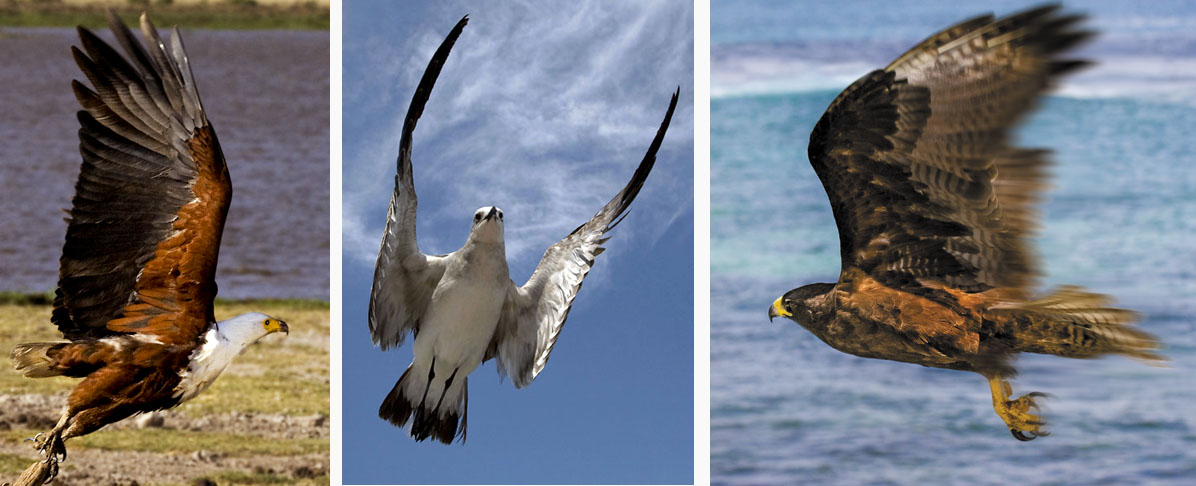
After posting the above picture here on my blog earlier this week, I received several emails asking for some bird photography tips. Here goes!

Above: Behavior shots are often more impressive than portraits. To get behavior shots, you need to be patient and lucky. I was lucky to get this shot, but the dove was not that lucky . . . .

If I could recommend one lens for bird photography, it would be the Canon 100-400mm IS. Image stabilization is must for hand-holding long lenses.

Don't be afraid to boost your ISO when you need a fast shutter speed to avoid camera shade and to stop action. What would you rather have? A picture with a bit of noise or a shot that is out of focus, soft and blurry.


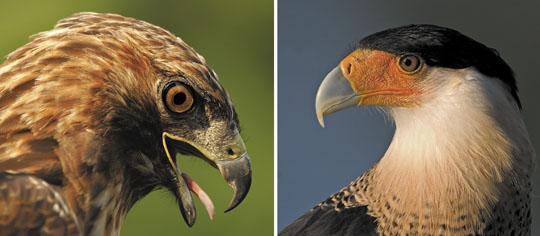
Above: These portraits are okay. However, the background is distracting in one shot and boring in the other. Remember: the background can make or break a shot. Maybe the one good thing about both pictures is that I shot at eye level.


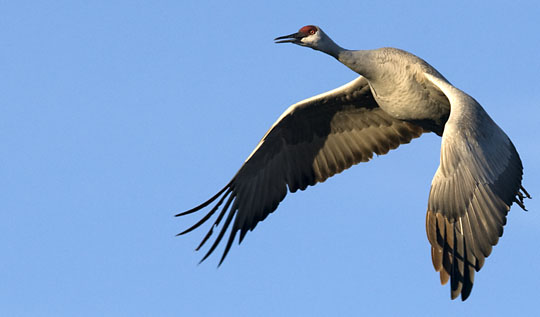
Above: Birds-in-flight shots are cool. To stop the action, use a shutter speed of at least 1/1000 sec. In Photoshop, selectively blur part of the wings to add a sense of motion to your still shot.


Above: And speaking of Photoshop, always envision the possibilities that await you in the digital darkroom.


Above: Try to get some light in the bird's eye. Select a good shooting position or use a flash. To extend the range of your flash, use a Better Beamer. I use one on my Canon Speedlite 580EX.

Info:


Above: When choosing a tele-extender, go with one that is made by your camera manufacturer. Also, 1.4x tele-extenders are usually sharper than 2x tele-extenders. I use a Canon 1.4X tele-extender on my Canon 100-400mm lens and Canon 70-200mm lens. 

Info:

Above: Another cool accessory is the Puffin Bad, designed by my friend Wayne Bennett.

The Puffin Pad was originally designed to fit over the window of your car, via a slot running the length of the underside.  However, the Puffin Pad is so versatile that it can be used on the beach to shoot eye level with shore birds, it can be used on gates, chair backs, tables, side railings of boats and more.

For more information and sales, go to www.puffinpad.com.


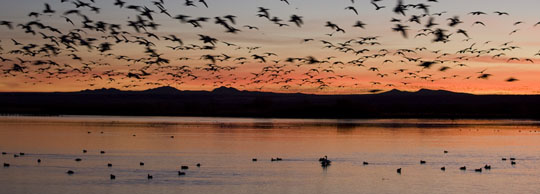
Above: Go where birds hang out. I took this picture in Bosque del Apache in New Mexico in early December. I used a shutter speed of 1/30th of a second to slightly blur the action.

Juan Pons and I will be leading a photo workshop to Bosque in early December 2011. Shoot me an email if you are interested in joining the photo and Photoshop fun. 


Above: Speaking of hanging out with birds, here is one of my favorite shots from a recent workshops to Alaska on which I was the co-pro leader with photo pro Hal Schmitt. Here is a link to more pictures and tips.

If you want to join Hal/me in 2012 for the Bald Eagle workshop, shoot me an email.


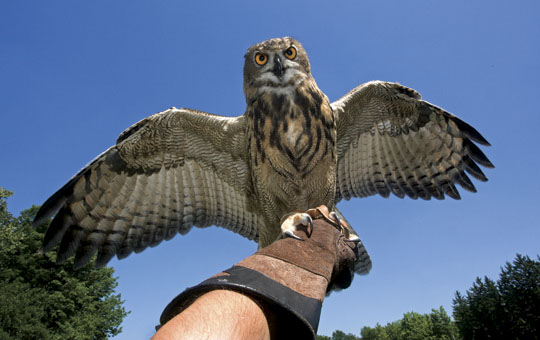
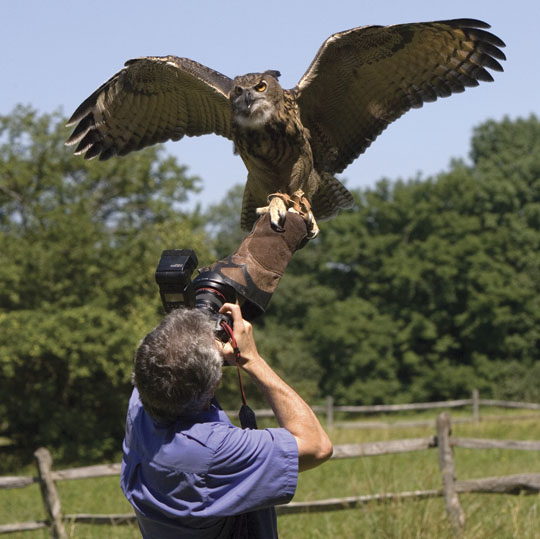
Above: Know everything about your camera - so you can shoot even with one hand. Also master your flash and daylight fill-in flash, so your pictures do not look like harsh flash pictures. The key is learning how to balance the light from the flash to the daylight.


Above: Have fun!

Explore the light, 
Rick