Battle of the HDR Photo Tips Round 2: Ratcliff vs. Sammon

Photography by Trey Ratcliff
It's Round 2 of the week-long Battle of the HDR Photo Tips: Trey Ratcliff vs. Rick Sammon. Thank you for joining us ringside.

Trey Ratcliff is some dude on the internet that runs Stuck in Customs. His mom visits his blog every day. If people leave bad comments, then his mom gets 'em.

Rick Sammon was at Woodstock and still tries to maintain the PLJ feeling of the '60s. He also scuba dived in Lake Baikal, Sibera and photographed the nerpa.

Here we go:

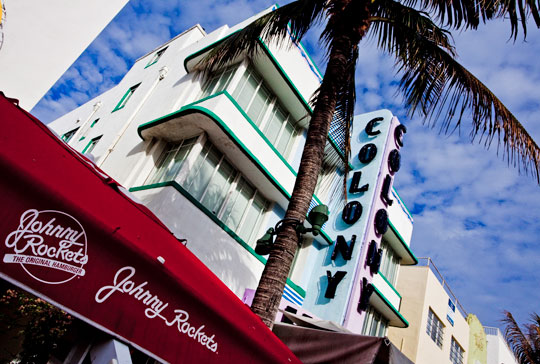
Ratcliff: I think all photographers like reflections, but HDR photographers doubly-like reflections!

If you’ve been taking photos for a long time, this new way of thinking about reflections may take some getting used to. If you are just doing a “regular’ photo, the reflections can sometimes come out flatly lit, over-exposed, or long-exposure-blurry. HDR can get around all that by combining the best bits of the various constituent images.

So, to that end, I try to set up the composition to ensure the interesting bits within the microcontrast are more than evident in the reflection. That is, there are bits of your photo that lend themselves to HDR more than others. Try your best to keep those bits front and center, and let all the other traditional compositional techniques (leading lines, etc) lead to those points of micro-contrast-tonal-mapping interest.

This is the amazing National Centre for the Performing Arts, or as I like to say, the 国家大剧院 — I find that rolls of the tongue a bit easier.

Photograph by Rick Sammon
Sammon: My first tip: Look for, and have fun with, reflections. For whatever reason, we love' em.

Think selectively, rather than globally - especially when it comes to sharpening. In most cases, it's not necessary to sharpen the entire image. If you sharpen soft and dark areas of a picture, you'll increase the amount of noise in those areas. Also, sharpening the main subject draws more attention to the main subject.

Thinking and working selectively is also important when it comes to saturation and contrast – as well as Levels and Curves. If you over-saturate an already saturated area of an image, for example, you may lose detail in that area. Same is true if you increase the contrast globally.

For the above reasons, I always bring my HDR images into Photoshop or Lightroom.

I took this image with my Canon 5D Mark II and Canon 15mm lens in the Great Buddha Hall at the Chaung-yen Monastery in Kent, NY - one of the places we shoot on my Croton Creative Workshop.
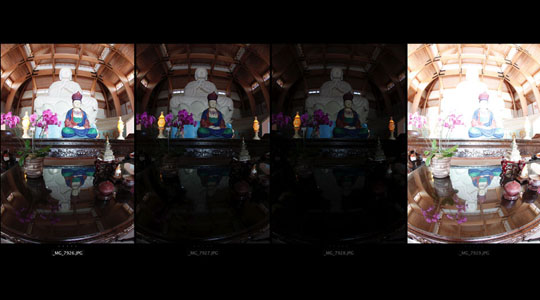

Above is a screen grab of the four images I used to create the HDR image.

Here's an important tip for shooting in Buddhist temples: Wear slip-on shoes, as you need to take them off before you enter the temple.
• • • 

To learn more about Trey's HDR work, click here.


To learn more about my latest HDR project, Rick Sammon's HDR Portfolio app for the iPad, click here.

Explore the light,
Rick
Battle of the HDR Tips Round 1: Ratcliff vs. Sammon

Photograph by TreyRatcliff
It's Round 1 of the week-long Battle of the HDR Photo Tips: Trey Ratcliff vs. Rick Sammon. Thank you for joining us ringside.

Trey Ratcliff is some dude on the internet that runs Stuck in Customs. His mom visits his blog every day. If people leave bad comments, then his mom gets 'em.
Rick Sammon was at Woodstock and still tries to maintain the PLJ feeling of the '60s. He also scuba dived in Lake Baikal, Sibera – where he photographed the nerpa.

Here we go:

Ratcliff: When I give these tips, just imagine a Michael-Weston-voice over.

Sometimes, when you’re out shooting, it’s best to plan to improvise. You gotta have a plan, but you also need to think back on our feet. Many photographers (myself included) have an introverted side, where you kind of feel comfortable blending into the background, quietly making magic through your lens… but that won’t help you change your future when opportunity arises spontaneously

As an HDR photographer, I am intimately aware of “HDR situations” — those times when there is more light than my camera can handle. This was one of those situations. I had already scouted the entire island of Ibiza, and I knew where the sun was setting and it’s relative location to landmarks of interest. So I knew this beach was going to be perfect. It was going to be a great sunset shot anyway, but then I saw this Italian girl with some friends. She was jumping around, happy, and very spunky. I think anyone that wears a bathing suit like that has a bit of spunky-coefficient that is to be expected. Anyway, I thought she would add something to the beauty of the scene, so to speak, and I went over to talk to her.

She didn’t speak a lick of English, but there is an international language of gestures and “fun communication”. If you both go into it with a nice effort, then it’s really fun to try to talk to someone with this way. Anyway, she said her name was “Wendy” – Italian is “Guendalina.”

I asked her if I could take a photo while she strolled into the ocean. She excitedly said yes and bounced down to the beach. I already had my tripod set up with the background how I wanted it, and I motioned, giving her a specific direction in which to walk. Without a hitch, she walked right in with no problems, and I fired away. There was no need for a re-take, we got it on the first try.

I normally would take 5 exposures here, from +2 to -2. If the sun was up, I would have done +3 to -3. But, this gal wasn’t standing still, nor did I want her to. Since I always shoot in RAW mode (JPEG is for children), I knew that one of my middle exposures would be perfect. I used one of those RAWs to create the final HDR you see at the opening of this post.

Photograph by Rick Sammon

Sammon: Go from flat to fab. When there is little contrast in a scene, HDR images tend to look flat. There are many ways to boost contrast, such as increasing the contrast in Lightroom, Photoshop and Aperture. The fastest and easiest way to boost contrast, as well as color and detail, is to use the Spicify filter in Topaz Adjust.

In Photoshop, Curves is the best way to increase the contrast range in a scene.


In Curves, create an "S" curve. But first, move the top and bottom of the Curve lightly inward. That helps to preserve highlights and shadows.

Middle Exposure.
Above: Middle exposure of three-exposure HDR bracketing sequence: 0, +2 EV and -2 EV.


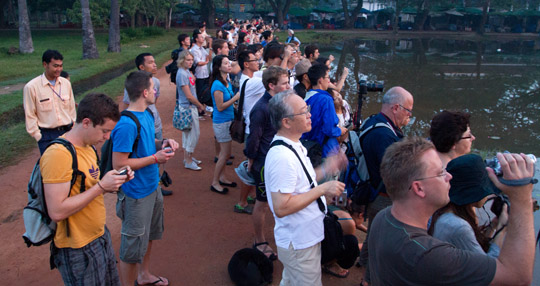
I took the pictures for the HR sequence at Angkor Wat, Cambodia about an hour after sunrise, when everyone, including my wife and I, were heading back to the parking lot. The boat was in a perfect position to balance the scene - filling up the dead space. If you go to Angkor Wat, get there about one hour before sunrise. It's packed with tourists and photographers with tripods!

• • •

 To learn more about Trey's HDR work, click here.

To learn more about my latest HDR project, Rick Sammon's HDR Portfolio app for the iPad, click here.

Explore the light,
Rick
Soon Come: Gale Tattersall Interview on DPE Podcast

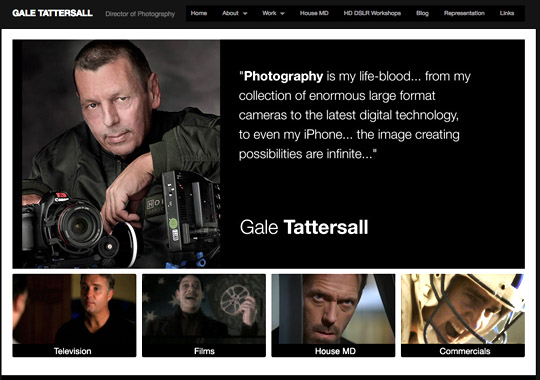
Soon come: My interview on the Digital Photo Experience podcast with Gale Tattersall, whose many accomplishments include being the director of photography on "House, M.D."

We talked about his craft, his HD SLR workshops, his work with the Canon 5D Mark II,  his family. . . and of course "House."


Juan Pons and I love doing the podcast. We have interviewed some of today's top pros – and have answered many of your questions. Keep those questions coming. Go to our site to see how to submit a question.

Gale is a true pro. An inspiration. Stay tuned.

Explore the light,
Rick

Blogging About Blogging?

Well, I never thought I'd be blogging about blogging. But hey, if Kramer can write a coffee table book on coffee tables, I guess it's ok.

I just wanted to thank the folks at "Blog of Note" for naming my blog a Blog of Note. Kinda cool.

I'll keep blogging away.


Speaking of which . . . the "Battle of the HDR Tips - Ratcliff vs. Sammon," starts on Trey's site and on my site on Monday. Stay tuned! Scroll around here for more info.

Explore the light - and never underestimate the power of blogging,
Rick


Just Released: Rick Sammon's HDR Portfolio iPad App - A great way to master HDR photography.

 
My latest how-to iPad app - Rick Sammon's HDR Portfolio - is here!

And speaking of "here," the "Battle of the HDR Photo Tips, Ratcliff vs. Sammon," starts here on my blog, as well as on Trey Ratcliff's site, any day now. Join us ringside for the HDR photo fun.

Developed my Dr. Dave Wilson, who also developed my iPhone and iPad apps, Rick Sammon's 24/7 Photo Buffet, the interactive app features solid how-to information (tips, tricks and techniques) and more 300 images, including 30 of my latest HDR images. Several movies, including a clip me shooting an HDR sequence, are also included.

What's more, the app offers one of the coolest features I have seen when it comes to teaching and illustrating HDR: HDR Dissolve™.


To activate HDR Dissolve™ Simply touch the photo to see it magically transform into the final HDR image. Normal images dissolve into great HDR images - just by touching them! In some cases, a set of three original photos are provided, followed by one or more processed HDR images. Nice work Dr. Dave!


The app is divided into four major sections, making it easy to access the photographs and how-to information.

• Introduction – Dr. Dave and I cover the basics of HDR image making. Photographs, text and movies are provided for fast learning.

• Inside – Learn how to shoot in extreme contrast situations, and learn how to see the light and exposure for the dynamic range of a scene.

 • Outside – Travel with me around the world and see how he captures cityscapes, landscapes, and interior scenes, during the day and at night.

 • Nature – Learn how to capture the beauty of nature without being limited by the existing lighting conditions.  

This is not an app to process or take pictures. Please do not buy this app to edit your photos – it doesn’t so that! It is an educational app for digital SLR and compact camera photographers.


For each HDR image, I provides the location, number of exposures, processing program used, and tips about HDR and/or standard photography. EXIF camera and exposure info is also included for many images. A quick e-mail feature lets you share any image with family and friends.

Size: This app contains more than 100 MB of movies and photos. It’s self-contained, so you don’t need an Internet connection to use it.


To order the app and start the HDR learning and fun, click here.

$ave a Few Buck$: If you are new to HDR image-making and need an HDR plug-in (Nik Software's HDR Efex Pro) or program (HDR's Photomatix), click here to get the program/plug-in . . . and a discount (if you use the appropriate discount codes). While you are there, check out Topaz Adjust, which also helps expand the dynamic range of an image.

To see all my apps, click here.

Explore the light,
Rick

P.S. If you don't have an iPad, check out my book on HDR photography. It's pack with info and photo, too!