A Favorite From Today's Shoot with Westcott

© rick sammon.jpg

Here's a favorite shot from today's shoot with Westcott.

I am here in Toledo, Ohio shooting a bunch of videos for Westcott University.​ My videos will be up in a few months.

​For now, to light this scene I used a Westcott Rapid Box 26" Octa as my main light (to camera left) and a Westcott Rapid Box 10x24" Strip as a hair light. These relatively new soft boxes offer rapid shooting for me, who is known as the "shoot and scoot photographer."

I used daylight fill-in flash to get a good exposure of our model and to capture the outdoor scene behind our model.​ My Canon 600EX RT speedlites were set to ETTL; my Canon 5D Mark III camera was set to the Manual exposure mode.

To add to the mood of the setting, I used the Duplex Filter in Nik Color Efex Pro. For a great deal on ALL the Nik plug-ins, click here.​

I can't wait to see the videos - and for you to see the videos. Lots of how-to info, including camera settings.​

​For now, if you'd like to learn more about light, check out my classes on Kelby Training.

Explore the light,
Rick

This site powered by (designed and hosted on) Squarespace. Use one-click to get started with your own awesome Squarespace site.

Top Tips for Cool Zoo Pix

rick sammon.jpg

Even though I have been to Africa several times (and will be returning next year for my Kenya digital photograph workshop), I still enjoy photographing at zoos - especially at the Bronx Zoo, where I took the images for this post.

Here are some helpful tips for your next zoo shoot.

Go for behavior shots, like the ones you see here, as opposed to static portraits. Behavior shots tell more of a story, but are, admittedly, harder to capture.​

Call the zoo in advance and ask if any groups will be at the zoo during your proposed shoot times. Several bus loads of kids, as cute as the kids may be, may make shooting in confided spaces, such as Jungle World at the Bronx Zoo, a bit tricky.​

Speaking of Jungle World, when you are in an indoor exhibit where it is humid, don't change lenses. If you do, your lens and mirror can fog. Worse still, your image sensor could fog.

Ask beforehand if a tripod or monopod is allowed. Some zoos say "no" due to insurance policies.

Also ask about feeding times. You may get more action shots before and during feeding times, as opposed to getting sleeping shots after feeding times.​

Lens recommendations:​ 100-400mm for close-ups of the animals, 24-105mm for environmental shots.

For portraits of the animals, shoot at a wide aperture to blur the background, which may be a dead giveaway that your picture was taken in a zoo.

You can blur a foreground wire fence if you hold a telephoto lens very close to the fence and shoot at a wide aperture.​

You'll definitely want to pack a polarizing filter to reduce glare on the windows of the displays.​

Pack a flash for daylight fill-in flash shots.​

Pack light and have easy access to your gear and gear bag, which you want to keep in sight at all times.​

Inside: Don't be afraid to boost your ISO to get a fast shutter speed, which is often needed for steady shots with long lenses.​

Where ever you shoot, lighting and composition is important. You can lean about both topics by watching my on-line composition and lighting classes.​

Have fun on your next photo adventure at the zoo.

shows giraffe rain.jpg

Shoot me an email if you are interested in my 2014 Kenya Photo Safari.

Explore the light,
Rick

P.S. If you want to add a creative touch to your images, play with plug-ins. My favorites are listed on my Save on Plug-ins page.​

Screen Shot 2012-12-17 at 1.49.33 PM.png

This post sponsored by Adorama - great gear at great prices.

This site powered by (designed and hosted on) Squarespace. Use one-click to get started with your own awesome Squarespace site. ​

Today's Guest Blogger: Don Komarechka

1.jpg

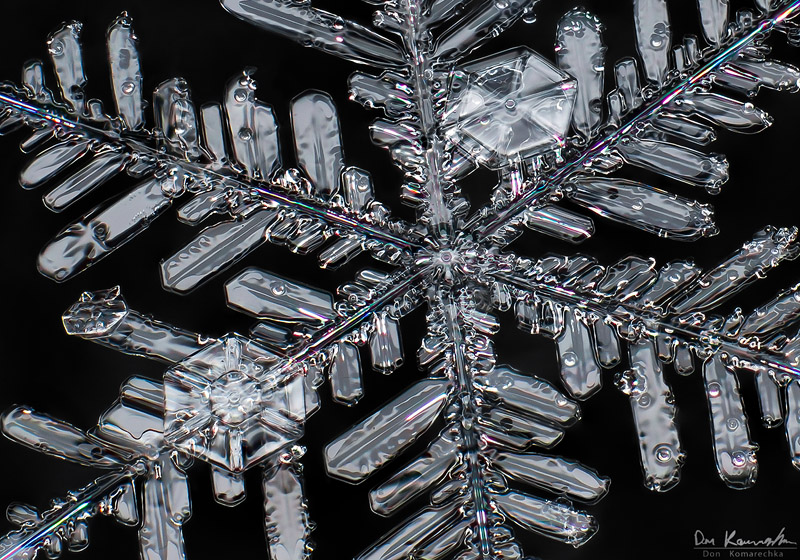
Thanks Rick for letting me ramble a bit on your blog! As a science-minded individual, photography allows me to see the world in ways I could never imagine with my own eyes. This has developed into a style and over-arching concept behind my work: to photograph the unseen world. From limitless star scapes all the way down to the smallest objects of little significance.

My neighbors think I’m crazy, and it’s the logical thing to do. Seeing me grapple a monstrous camera while flashing rapid pulses of light at a black mitten, what other explanation could come to mind? I’m photographing snowflakes.

Opening Image: Shimmering snowflake

​As a young child seeing their first snowflake, you might come across one of these beauties and stare for a while, or it may fall on your tongue and disappear instantly. My method of photographing snowflakes uses reflected light instead of light shining through it. This allows me to play with the angles of light and camera to get a brightly reflective surface.

Inner Future

2.jpg

Some snowflakes are smaller than you’d ever notice, even as an inquisitive child. Crystals such as this one measure roughly 1mm across, and contain patterns and geometry with a high degree of symmetry. Look closely to the center and you’ll see the shape of a snowflake hidden in the empty space. A 6:1 magnification is required to get this close, and I use a Canon MP-E 65mm macro lens with extension tubes as the tool of choice.

 Hanging On

3.jpg

Snowflakes can be difficult to isolate, and you’ll often encounter smaller crystals attached to larger ones. All my snowflake images are focus-stacked (in Photoshop), and in this case 43 separate frames at different focus points are combined to make the entire structure crisp and sharp.

Bumpy Ride

4.jpg

When observing snowflake, you’ll often see many with bumps, as if it was dipped in diamonds. This is called “rime”, and occurs when a snowflake passes through water droplets during its formation. All of these images are photographed on a black mitten as a background.

Hidden Colours

5.jpg

Physics plays a huge role in the shape, and also the color of snowflakes. Prism refraction may be responsible for the branches, and the center is caused by optical interference. There’s a lot of science directly observable in your everyday snowflakes!

 The Snowflake Book Project

I’m currently crowd-funding the production of a 300-page hardcover book on snowflakes. The photography and techniques, science and physics will all be explored. Help out the project and make “Sky Crystals: Unraveling the Mysteries of Snowflakes” a success! Click here for info. 

​Thank you again Rick for letting me share your space.

Contact me:
Google+

Website

This post sponsored by Adorama - great gear at great prices.

Screen Shot 2012-12-17 at 1.49.33 PM.png

This site powered by (designed and hosted on) Squarespace. Use one-click to get started with your own awesome Squarespace site.

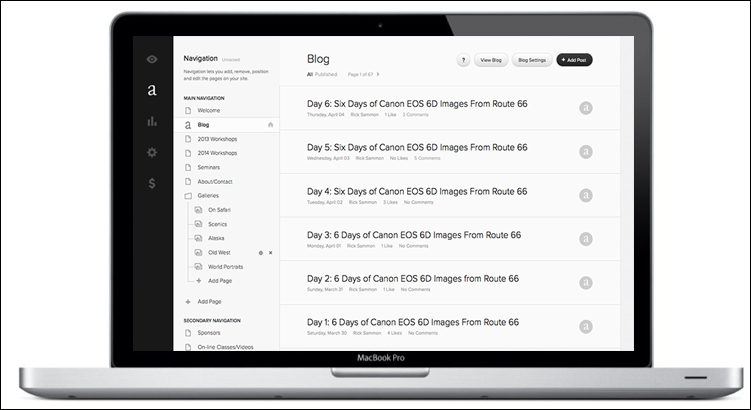
Squarespace Makes It Easy to Post - even when you are on the road!

Screen Shot 2013-04-06 at 10.35.30 AM.png

Thank you all for following along during my most recent blog post series: Six Days of Canon EOS 6D Images from Route 66. You can scroll down to see the individual posts. Each post includes photo tips that will help you make better pictures.

​One of the reasons why I was able to post every day for the road: the ease in which Squarespace is designed.

Squarespace lets me (and you) quickly and easily drag and drop photos into a post and even edit the photos within the platform. Editing, moving pictures up and down, and adding links are a snap. What's more, all this is fun!I

If you are looking for a new Web site, check out Squarespace and take advantage of the free trail. Use one-click to get started with your own awesome Squarespace site.

To learn more about Squarespace, check out this post: 7 Reasons to Switch to Squarespace.

rick sammon for blog.jpg

Above is an image from Chloride, AZ that I did not include in the series. I enhanced the image with the Polaroid Transfer filter in Nik Color Efex Pro. All my plug-ins are listed on my Plug-ins page.

Tip: Adding a creative filter can remove some of the reality from an image. When you remove some of the reality, your picture can look more creative.​

Explore the light,
Rick

This site powered by (designed and hosted on) Squarespace. Use one-click to get started with your own awesome Squarespace site.