Battle of the HDR Photo Tips Round 3: Ratcliff vs. Sammon. Today: Thinking and Mystery


It's Round 3 of the week-long Battle of the HDR Photo Tips: Trey Ratcliff vs. Rick Sammon. Thank you for joining us ringside.

Trey Ratcliff is some dude on the internet that runs Stuck in Customs. His mom visits his blog every day. If people leave bad comments, then his mom gets 'em.
Rick Sammon was at Woodstock and still tries to maintain the PLJ feeling of the '60s. He also dived in Lake Baikal, Sibera where, under the ice, he photographed the nerpa.

Away we go:

Sammon: Think.

Think like a painter. Try to create an image that looks more like a painting than a still photograph.


Think like an artist. Don't care what others think about your work. 

Think and create for yourself. Remember: You are the audience.

Think about the feeling of an image - and don't get too caught up with tech stuff, as important as it is.

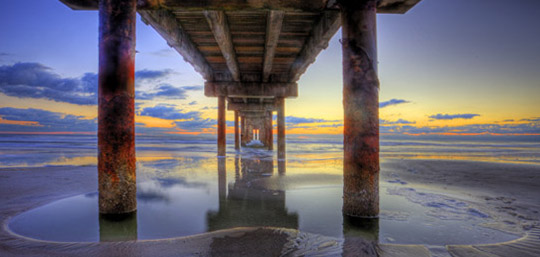
Think about what others may see in your picture - like the heart that you see in my HDR image of the St. John's Pier in St. Augustine, Florida.

Think. :-)
Photograph by Trey Ratcliff
Ratcliff: Today, I will talk a bit about leaving some mystery in your shot.

HDR processing can already give an impressionist-feel to your photo.

Now, this doesn’t work for anyone. You’ll find photographers out there that want absolute detail and precision with zero noise in every pixel of the photo. But I don’t listen to them… It’s more important to me to provide the feeling of something rather than the actual something.

Also, I like to leave things in my photos that are mysterious and “could be” mistakes. Often times, these are interesting enough to make people wonder and become somewhat attached to the photo. You don’t want the bit to be so strange that it is distracting and off-putting… but just a bit mysterious perhaps.

In the photo above, I left in the dirt-zamboni because it was kinda strange and different. Upon closer inspection, you can see that there was recently a bullfight and that thing was smearing the blood across the sand.
• • •


To learn more about Trey's HDR work, click here.

To learn more about my latest HDR project, Rick Sammon's HDR Portfolio app for the iPad, click here.

Explore the light,
Rick

February 2011 Winner of My "You Light It!" Photo Contest Announced: Christopher Martin


Man o man, it was really hard to choose the winner of my You Light It! Photo Club Contest

Interestingly enough, our two favorite photographs were taken by the same person - Christopher Martin.

Yo Chris, you need to contact me to schedule the 1/2 portfolio review via Skype. ricksammon@me.com.

Everyone..... keep shooting! Great work for sure.

Check back here on April 1 or so to see the next winner. It could be you!


For info on my Light It! app, click here.

Best,
Rick


Trust Is Important In People Pictures

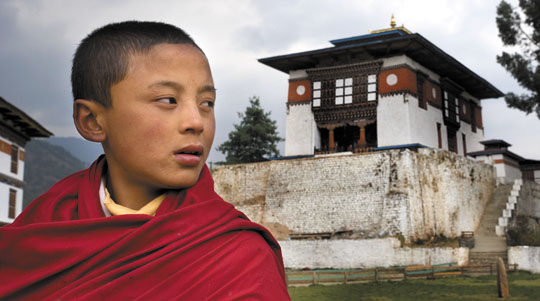
My main photography passion is photographing people – mostly strangers in strange lands, such as this young monk-in-training, posing in a light rain, by a dzong in the Royal Kingdom of Bhutan.

Why is this my passion? Because getting accepted into a stranger's life for a few minutes, and gaining their trust, is a totally cool feeling for me. Sure, it's a challenge, but a challenge that has a very nice reward: a photograph.

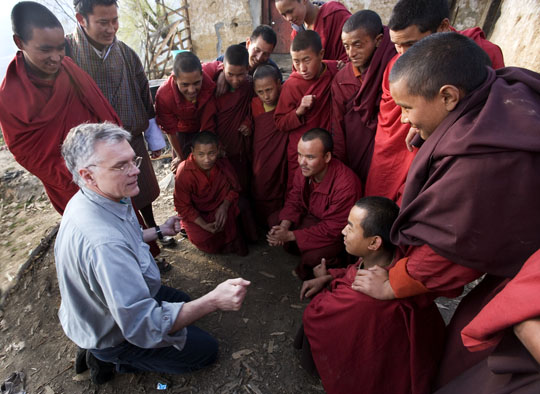
One way I try to gain acceptance and trust is to do magic tricks for the folks I encounter abroad. Here I am doing a simple coin trick for some Buddhist monks in Nepal. Take a close look at all their faces. I am trying hard to entertain them, which I did! (Eventually, I showed them how to do the trick. We all had fun before the photo session.)

So, traveling around the world and photographing people is a blast. Recently, however, I have been taking pictures of my neighbors - fun for me, important for them.

But here, too, gaining acceptance and trust as someone who is going to picture them is important. Before I start shooting, I joke around and learn more about the subject - what they want out of the photo session. I want the subject to feel important. At ease. Relaxed. This is an important step when it comes to photographing people.

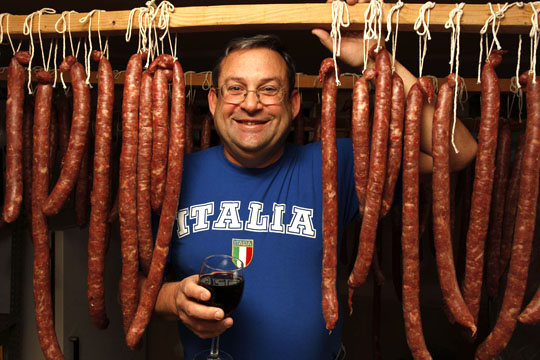
Last night, I photographed my dentist, Dr. Mobilla - whose passion is making wine and sausage (and fishing, but that is another photo session). Before the sausage photo session, I learned a lot about making sausage and wine in one's basement. I did not start shooting immediately.

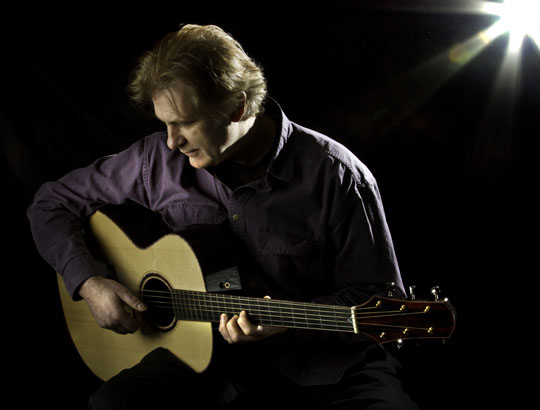
Last week I photographed my neighbor Peter Calo - whose passion is playing guitar. Before the session, I played a few chords for him. I wanted Peter to like me (in this case as a fellow musician), as I do all my subjects. If they like me, they trust me. Again, when it comes to photographing a person, trust is very important.

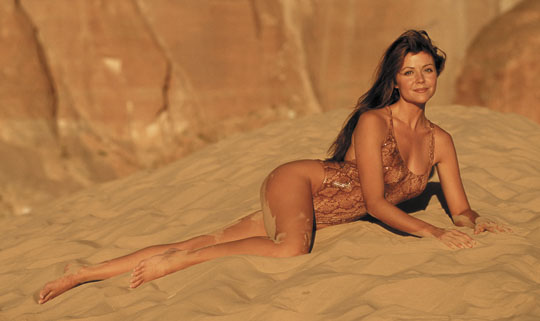
Above is a picture I took of a model on the shores of Lake Powell. Before I began shooting, I talked to the model about what it was like being a model, her family, etc. I ask here to choose a pose, rather than saying, "do this, do that."

Model Laurence G. Yang Photographed by Kade Lam
Speaking of models, their feelings and trust, one of my model friends, Laurence G. Yang, trusted photographer Kade Lam to take this beautiful portrait.

About the picture, Laurence says, "Every time I see this picture, "mesmerizing" whispers in my heart. "I'd have to say this it one of my favorites. It well defines elegance and also captivates a strong and sexy moment."

Laurence, by the way, is also the editor-in-chief of Runway Weekly.


Photo Info from Kade:
Two-light setup...300w self-contain units from Elinchrom.
7-foot black panel placed on the model's right side.
Softbox on the right side of the model for high-lighting.
Unit on the model's left side was bounced of a wall.
Camera exposure:125@F8.

• • •

When you are photographing a person, sure, think about technique, but first think about gaining the person's trust and respect.

Explore the light,
Rick

For more tips on photographing people, see my book, Face to Face:


Battle of the HDR Photo Tips Round 2: Ratcliff vs. Sammon

Photography by Trey Ratcliff
It's Round 2 of the week-long Battle of the HDR Photo Tips: Trey Ratcliff vs. Rick Sammon. Thank you for joining us ringside.

Trey Ratcliff is some dude on the internet that runs Stuck in Customs. His mom visits his blog every day. If people leave bad comments, then his mom gets 'em.

Rick Sammon was at Woodstock and still tries to maintain the PLJ feeling of the '60s. He also scuba dived in Lake Baikal, Sibera and photographed the nerpa.

Here we go:

Ratcliff: I think all photographers like reflections, but HDR photographers doubly-like reflections!

If you’ve been taking photos for a long time, this new way of thinking about reflections may take some getting used to. If you are just doing a “regular’ photo, the reflections can sometimes come out flatly lit, over-exposed, or long-exposure-blurry. HDR can get around all that by combining the best bits of the various constituent images.

So, to that end, I try to set up the composition to ensure the interesting bits within the microcontrast are more than evident in the reflection. That is, there are bits of your photo that lend themselves to HDR more than others. Try your best to keep those bits front and center, and let all the other traditional compositional techniques (leading lines, etc) lead to those points of micro-contrast-tonal-mapping interest.

This is the amazing National Centre for the Performing Arts, or as I like to say, the 国家大剧院 — I find that rolls of the tongue a bit easier.

Photograph by Rick Sammon
Sammon: My first tip: Look for, and have fun with, reflections. For whatever reason, we love' em.

Think selectively, rather than globally - especially when it comes to sharpening. In most cases, it's not necessary to sharpen the entire image. If you sharpen soft and dark areas of a picture, you'll increase the amount of noise in those areas. Also, sharpening the main subject draws more attention to the main subject.

Thinking and working selectively is also important when it comes to saturation and contrast – as well as Levels and Curves. If you over-saturate an already saturated area of an image, for example, you may lose detail in that area. Same is true if you increase the contrast globally.

For the above reasons, I always bring my HDR images into Photoshop or Lightroom.

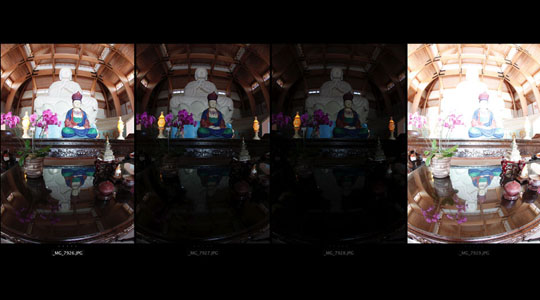
I took this image with my Canon 5D Mark II and Canon 15mm lens in the Great Buddha Hall at the Chaung-yen Monastery in Kent, NY - one of the places we shoot on my Croton Creative Workshop.


Above is a screen grab of the four images I used to create the HDR image.

Here's an important tip for shooting in Buddhist temples: Wear slip-on shoes, as you need to take them off before you enter the temple.
• • • 

To learn more about Trey's HDR work, click here.


To learn more about my latest HDR project, Rick Sammon's HDR Portfolio app for the iPad, click here.

Explore the light,
Rick

Battle of the HDR Tips Round 1: Ratcliff vs. Sammon

Photograph by TreyRatcliff
It's Round 1 of the week-long Battle of the HDR Photo Tips: Trey Ratcliff vs. Rick Sammon. Thank you for joining us ringside.

Trey Ratcliff is some dude on the internet that runs Stuck in Customs. His mom visits his blog every day. If people leave bad comments, then his mom gets 'em.
Rick Sammon was at Woodstock and still tries to maintain the PLJ feeling of the '60s. He also scuba dived in Lake Baikal, Sibera – where he photographed the nerpa.

Here we go:

Ratcliff: When I give these tips, just imagine a Michael-Weston-voice over.

Sometimes, when you’re out shooting, it’s best to plan to improvise. You gotta have a plan, but you also need to think back on our feet. Many photographers (myself included) have an introverted side, where you kind of feel comfortable blending into the background, quietly making magic through your lens… but that won’t help you change your future when opportunity arises spontaneously

As an HDR photographer, I am intimately aware of “HDR situations” — those times when there is more light than my camera can handle. This was one of those situations. I had already scouted the entire island of Ibiza, and I knew where the sun was setting and it’s relative location to landmarks of interest. So I knew this beach was going to be perfect. It was going to be a great sunset shot anyway, but then I saw this Italian girl with some friends. She was jumping around, happy, and very spunky. I think anyone that wears a bathing suit like that has a bit of spunky-coefficient that is to be expected. Anyway, I thought she would add something to the beauty of the scene, so to speak, and I went over to talk to her.

She didn’t speak a lick of English, but there is an international language of gestures and “fun communication”. If you both go into it with a nice effort, then it’s really fun to try to talk to someone with this way. Anyway, she said her name was “Wendy” – Italian is “Guendalina.”

I asked her if I could take a photo while she strolled into the ocean. She excitedly said yes and bounced down to the beach. I already had my tripod set up with the background how I wanted it, and I motioned, giving her a specific direction in which to walk. Without a hitch, she walked right in with no problems, and I fired away. There was no need for a re-take, we got it on the first try.

I normally would take 5 exposures here, from +2 to -2. If the sun was up, I would have done +3 to -3. But, this gal wasn’t standing still, nor did I want her to. Since I always shoot in RAW mode (JPEG is for children), I knew that one of my middle exposures would be perfect. I used one of those RAWs to create the final HDR you see at the opening of this post.

Photograph by Rick Sammon

Sammon: Go from flat to fab. When there is little contrast in a scene, HDR images tend to look flat. There are many ways to boost contrast, such as increasing the contrast in Lightroom, Photoshop and Aperture. The fastest and easiest way to boost contrast, as well as color and detail, is to use the Spicify filter in Topaz Adjust.

In Photoshop, Curves is the best way to increase the contrast range in a scene.


In Curves, create an "S" curve. But first, move the top and bottom of the Curve lightly inward. That helps to preserve highlights and shadows.

Middle Exposure.
Above: Middle exposure of three-exposure HDR bracketing sequence: 0, +2 EV and -2 EV.


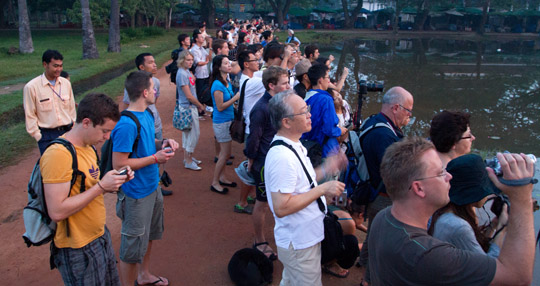
I took the pictures for the HR sequence at Angkor Wat, Cambodia about an hour after sunrise, when everyone, including my wife and I, were heading back to the parking lot. The boat was in a perfect position to balance the scene - filling up the dead space. If you go to Angkor Wat, get there about one hour before sunrise. It's packed with tourists and photographers with tripods!

• • •

 To learn more about Trey's HDR work, click here.

To learn more about my latest HDR project, Rick Sammon's HDR Portfolio app for the iPad, click here.

Explore the light,
Rick