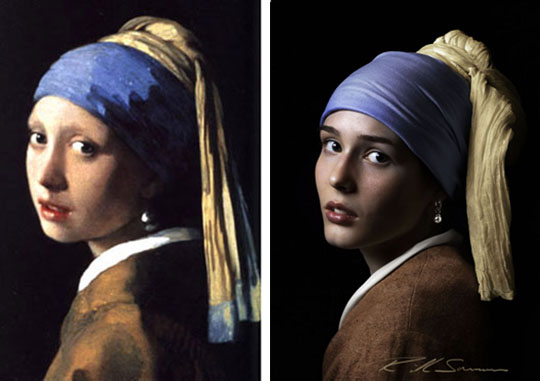
Part I: Girl with a Pearl Earring - The Photograph

Photograph on right © Rick Sammon. All rights reserved.
One of my favorite paintings is, "Girl with a Pearl Earring" by the Dutch master Johannes Vermeer. The painting has been referred to as, "The Mona Lisa of the North." Hey, I like it even better than the Mona Lisa.

One of my favorite movies is "Girl with a Pearl Earring," starring Scarlett Johansson.

Both the painting and the movie inspired today's shoot. I wanted to recreate the lighting and look and feel of the portrait with my digital camera and bit of Photoshop work. I made the portrait in my office – I don't have a studio.

I'm kinda jammed right now, but tomorrow or the next day I will show you some behind-the-scenes shots from the shoot. I'll also share the tech info on the making of the "Girl with a Pearl Earring - The Photograph."

Okay, a quick tip: I used the Portrait Smooth effect in Topaz Adjust to smooth out the model's skin. For more on Topaz Adjust, click here.

Stay tuned.

For now, try this type of "self assignment" at home.  After all, it's Sunday, a day off for many folks. Find a painting that you admire, see the light, note the props, and try to make a photograph that looks like the painting.

Another idea is to find a photograph that you like and . . . :-)

I teach stuff like this on some of my workshops and at my seminars. Join the fun!

Explore the light,
Rick

P.S. If you like photographing people, you might like my book, Face to Face:


Battle of the HDR Photo Tips Round 7: Ratcliff vs. Sammon

Photograph by Trey Ratcliff
It's Round 7 – the final round of the week-long Battle of the HDR Photo Tips: Trey Ratcliff vs. Rick Sammon. Thank you all for sharing in the HDR fun this week!

Trey Ratcliff is some dude on the internet that runs Stuck in Customs. His mom visits his blog every day. If people leave bad comments, then his mom gets 'em.

Rick Sammon was at Woodstock and still tries to maintain the PLJ feeling of the '60s. He also dived in Lake Baikal, Sibera, where he photographed the nerpa.

Here we go:

Ratcliff: We have an area of StuckInCustoms.com called The Clubhouse (people that get the video above get access) — I asked members in there to add their favorite short tips, and here they are a few:

Alex Suarez - “When shooting from a tripod, I like to hang my camera bag from the center column. Adding this extra weight firmly plants my tripod, further reducing the chance of camera shake.”

Marc (marcp_dmoz) – “If you are shooting in low light conditions and you can’t use a tripod, switch ‘Auto ISO Sensitivity Control’ on when bracketing for HDR.”

Eden Brackstone – “Never process your shots the same day you take them, allow your creative energy to build up and apply it when you will get the best results. Then, wait some more and revisit it. Ultimately, a late and well processed image is more valuable than a rushed one that you regret…”

And here is my last tip for the "battle" with Rick: “Practice RAW HDR processing a lot… there are countless moments that just don’t happen in brackets (like the photo above).”

Did you miss my the other tips?  Here they are, listed out:

Photograph by Rick Sammon
Sammon: Put the viewer in the scene. One way to accomplish this goal is to use a strong foreground element. Also, it's easier for the view to picture himself or herself in scene if everything in the scene is in focus – just like a scene looks to our eyes.To accomplish that goal, use a wide-angle lens, small aperture and focus 1/3 into the scene.

For this shot, set up my tripod in the back sat of this old car and held very very still while I shot.


Hey! I don't have a Clubhouse like Trey, but I do have a flickr group where photographers can share their work. Click here to join the HDR fun!

To recap the entire "battle," just type in Battle of the HDR tips in the search window of this blog.

• • •

To learn more about Trey's HDR work, click here.

To learn more about my latest HDR project, Rick Sammon's HDR Portfolio iPad app - a how-to app packed with tips, click here.

Thank you Trey for agreeing to the "battle," and thank you all for joining us ringside.

Explore the light,
Rick

Battle of the HDR Tips Round 6: Ratcliff vs. Sammon. Today: People in HDR Pictures.

Photograph by Trey Ratcliff
It's Round 6 of the week-long Battle of the HDR Photo Tips: Trey Ratcliff vs. Rick Sammon. Only one more round to go after today! :-(

Trey Ratcliff is some dude on the internet that runs Stuck in Customs. His mom visits his blog every day. If people leave bad comments, then his mom gets 'em.

Rick Sammon was at Woodstock and still tries to maintain the PLJ feeling of the '60s. He also scuba dived in Lake Baikal, Sibera, where he photographed the nerpa - the only fresh water seal species in the world.

Here we go:

Ratcliff: Resist the temptation to carry HDR techniques over to people. They just never look good. This is a big reason HDR Video will never take off until there are algorithms to find people’s faces and skin tones to remove the HDR processing.

There is something about the human mind that does drink in the rich texture and colors of objects, clothes, skies, trees, etc — but that does not carry over to faces. Our anthropological wiring enables us to apply a different standard to faces… and this is one of many reasons not to HDR people!

The best way to ensure people don’t have HDR effects is to create two layers — the HDR layer and the original RAW layer. Create a masking layer and slowly mix in the appropriate skin tones.

Photograph by Rick Sammon
Sammon: My first tip: Follow Trey's advice. :-)

I took this shot in Miami's South Beach, which is filled with cool art-deco hotels, great music and cool dudes. Great nightlife, but also great sunrises - to the east, behind the dude. In the early morning, sunlight illuminates the hotels. Great light. (We shoot here on my Florida Photo Caravan.)

Making HDR images at night is cool, just like this cool dude. Be sure to capture the entire dynamic range of the scene. Use slow shutter speeds to blur moving lights, but make sure the main subject holds as still as possible. 

Use ghost-reducing features in HDR programs and plug-ins to avoid or reduce unwanted subject movement. Shoot at the lowest ISO possible. 

Keep in mind that the best time to take nighttime pictures is not at night, but rather at dusk, when there is still a bit of light in sky. A black sky equals a noise-filled sky. 

Photograph by Rick Sammon
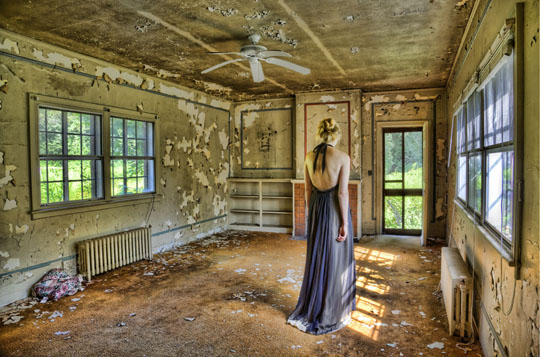
For the HDR image above, which I call the "Girl in the Black Dress," I used the technique that Trey describes. Click here to see a movie I made in the old building. It's about HDR!
 
• • •


To learn more about Trey's HDR work, click here.

To learn more about my latest HDR project, Rick Sammon's HDR Portfolio iPad app - a how-to app packed with tips, click here.

Explore the light,
Rick

Battle of the HDR Photo Tips Round 5: Ratcliff vs. Sammon. Today: Tips on Lenses.

Photograph by Trey Ratcliff
It's Round 5 of the week-long Battle of the HDR Photo Tips: Trey Ratcliff vs. Rick Sammon.

Trey Ratcliff is some dude on the internet that runs Stuck in Customs. His mom visits his blog every day. If people leave bad comments, then his mom gets 'em.

Rick Sammon was at Woodstock and still tries to maintain the PLJ feeling of the '60s. He also scuba dived in Lake Baikal, Siberia, where he photographed the nerpa.

Here we go:

Ratcliff: HDR is particularly appealing to landscape and architecture photographers. That means we all, by default, tend to pretty wide-angle with our shots. We keep seeing more and more awesome stuff we want to fit into the frame!

But don’t forget that HDR can also do amazing stuff for tight shots where the compression factor can give its own level of intrigue. This photo above is a 400mm shot (or so) of one of the most famous waterfalls in Yellowstone.

Photograph by Rick Sammon
Sammon: Choose a lens that helps you tell the story that you want to tell. Sometimes, a 400mm super telephoto lens is the best choice, and sometimes a super wide-angle lens is the best choice. For the above photograph, which I took in Angkor Wat, Cambodia, I used my Canon 14mm lens on my Canon 5D Mark II, which is a full-frame image sensor camera. 

When working on a photograph in the digital darkroom, remember this: When you remove some of the true color, you remove some of the reality. When you remove some of the reality, your picture can become more artistic.

Bonus tip: Always look up, always look down, always look back. Look and ye shall find - different picture opportunities.


Hey, if you have never tired HDR, you can get discounts on HDR programs and plug-ins by clicking here.

• • •

To learn more about Trey's HDR work, click here.

To learn more about my latest HDR project, Rick Sammon's HDR Portfolio iPad app - a how-to app packed with tips, click here.

Explore the light,
Rick

P.S. Did you know I have an HDR book, too? See below.

Edit First, Shoot Later - Says Guest Blogger/Emmy Award Winner David Leveen


 Happy Wide

This is a guest blog post from my friend (and Emmy Award winner) David Leveen, who was the shooter, sound man, producer, director and editor of my Wiley DVDs on the Canon Digital Rebel cameras. David was also the shooter (etc.) for all the videos on my Light It! app.

David and I will be doing a video workshop here in Croton July 6 - 9, 2011. For info, shoot David an email.

Take it away, David!
• • • 

Rick Sammon and I recently finished a small video project for Square. Square enables people from all walks of life to accept credit and debit cards. What better way to illustrate this than a real world situation that Rick finds himself in multiple times a year, selling his books at his workshops and seminars and loosing sales because he doesn’t take credit cards. 

With the basic premise in place we started out the process for shooting.

First Concept (unable to accept credit card):
  1. Establish location and activity. Rick selling his books (the dude has written 36) after a workshop, which he does all over the U.S.
  2. Introduce a workshop attendee wanting to buy a book and being frustrated that he can’t use his credit card
  3. Show frustration for Rick and his assistant Susan that he doesn’t take credit cards and looses a sale.
Second Concept (happily accept credit card):
  1. Establish location and activity. Rick selling his books after a workshop. Which he does all over the U.S.
  2. Introduce a workshop attendee wanting to buy a book and happy that he can use his credit card.
  3. Demonstrate how Square works
  4. Show a successful sale and purchase because of Square.
Because I was the director, cameraman and editor and knowing what our basic set up was, I went about plotting how I wanted to shoot. One of the things I’ve learned as an editor, which helps make the videos message work, is the ability to visualize the completed video before I shoot! Sounds weird I know but boy does it make everything a lot simpler when shooting. 

Basically it’s a storyboard but not on paper, but in your head.  First thing we did is to do multiple run throughs of the action. While listening to the performances for pacing, timing and hitting the key story telling points I mentally blocked my shots.

First Setup (unable to accept credit card): 

I knew I wanted to have a wide shot to establish where and what we were doing.

 Wide of Book Signing

My next shot was going to be a close up of the attendee (actually one of Rick's former book editors, and now the mayor, who lives in Croton) who at first is excited to buy one of Rick’s books and get it autographed. It was important to show his disappointment and frustration in not being able to do so.

CU of Leo

Finally I knew that we needed to show a two shot between Rick and his assistant (played by his wife, Susan) that showed their disappointment in the lose of a sale.

Loosing a Sale

Second Setup (happily accept credit card): 

The front piece was similar to the First Setup but now I needed to also shoot the Square demo.


I knew we needed to shoot the iPhone with the card dongle in it, the credit card sliding through and then the app doing its transaction.

App Shots

I also wanted the buyer’s curiosity in what Square was doing.

CU Happy Leo

Finally I needed to see Rick and Susan’s successful sale.

Two Shot End

The actual shoot was done with a single camera - the Canon7D with two lenses (Canon 17-40mm and Canon 24-105mm). I felt that it was important that I shoot the performances all the way though for each camera angle. That allowed me to control the pace and flow of the action between the actors (okay, I used this term loosely, hee hee) and allowed me the freedom in the edit room to mix up the different camera angles. 

For the lights, I used a Westcott TD5 Spyder Light Kit:

See video below.

In Part II (which will be a video) I’ll go through the lighting setup and all of the equipment used. The whole shoot took about an hour including rehearsals and setup. The actual edit and graphics took just over an hour.

So remember: Edit before you Shoot – and visualize what you want your video to look like from start to finish.

For more info, click here.

• • • 
Thank you David... for making the shoot fun, and easy!

Explore the light,
Rick


P.S. During my still photography Croton Creative workshop, David will be running a cooking class here in Croton. In his spare time, he runs Skillet here in Croton. Yum, Yum.


For info, contact him directly. Hey, if your spouse does not take pictures, he/she can take the cooking course during my workshop! 

As you can see, we have a ton of fun on Croton!