Gary Potts: Making Images With Impact

Image 1.jpg

Today's guest blogger is Gary Potts. Take it away Gary!

When I was with Rick in Oregon in September, along with co-host Alex Morley and both their lovely wives, Rick opened the first night’s group dinner with the question “What do you hope to achieve during the workshop/tour?” My answer was immediate—“I want to create images with IMPACT”.  Rick smiled and said there’d be numerous opportunities to do just that.  But what does it mean to shoot with IMPACT?  You hear the term all the time, especially when the judge at the salon or competition remarks, “A fine image, good color, interesting subject, but the overall presentation lacks IMPACT”.

Webster and others online tell us that IMPACT refers to abruptly changing something, or significantly altering our perceptions of a scene or subject, or maybe even making us say the proverbial “wow”.  One author failed to define IMPACT but rather tried to show it by a series of example images.  I think IMPACT can be defined, and my simple definition is—IMPACT (the noun) refers to the key aspects of the image that make us remember it, want to view it again and again, and cause us to differentiate it from other images of the same subject matter.  Let me give an example:

Opening Image: This is, as many of you recognize, the famous Oregon coastal scene called Thor’s Well.  It might be the equivalent of Utah’s Delicate Arch or the Smokie’s Oconoluftee Overlook or…you get the picture.  How to take it with IMPACT, especially with mid-afternoon sun and high contrast?  I took many, many frames—the joy of digital photography.  Don’t fear filling your cards; just bring plenty of cards!  This image was post-processed with one of my favorite filters, Nik’s Detail Extractor, located in Nik Collection>Color Efex Pro 4.0>Detail Extractor.  The image is a good record, but it lacks IMPACT by my definition above.

Image 2.jpg

Above: For this image, the motor drive was on Continuous High (for us Nikon shooters!) at 1/640th second, f8, 28mm lens, ISO 400.  It shows the decisive moment when the sea fills the well hole and erupts into the air—quite a sight if you haven’t seen it before, regardless of the light.  Again, Nik was used, and normal post-processing of Levels, Curves and a final sharpening.  We’re getting there!

Image 3.jpg

Above: I decided a human element might help out, and how can you go wrong with red?!  Fellow "Las Vegan" and friend Steve Casey stepped into the scene, and I took several with the sea doing various things in terms of eruption from the well.  This one has more IMPACT, perhaps…but then again, maybe the human element isn’t adding value here.  Ah, our photography is so subjective, isn’t it!

Image 4.jpg

Above: A bigger eruption of sea water with Steve in the frame adds another dimension of IMPACT.  The technical details are the same, with Nik being used throughout along with standard post-processing of Levels and Curves and sharpening.  What a pity that Steve was unwilling to move about six feet to the left and get ever so slightly closer to the well hole!  Some might argue you have two subjects here, Steve and Thor’s Well.  You might be right.

Image 5.jpg

Above: The image with greatest IMPACT might be the one above, taken by Alex Morley who stood behind two of us during our shoot.  He converted the file to monochrome and used the two human elements as a frame for a significant eruption from the well.  The sunburst adds to the drama, and our silhouettes don’t distract from the central action.  THIS image has IMPACT in my humble opinion, and thanks to Alex for sharing it with us.

When we ended this workshop, we all brought 5 images to the conference room for a final showing.  I remember a few of them very, very well and thought to myself as we all do from time to time “wish I’d taken that scene”.  Those images, the ones with lasting  memories of techniques used, lighting conditions, composition, and all the other tools in our bag of tricks are truly the ones with IMPACT.


National Parks Closed? Shoot in State Parks!

rick sammon copy 4.jpg

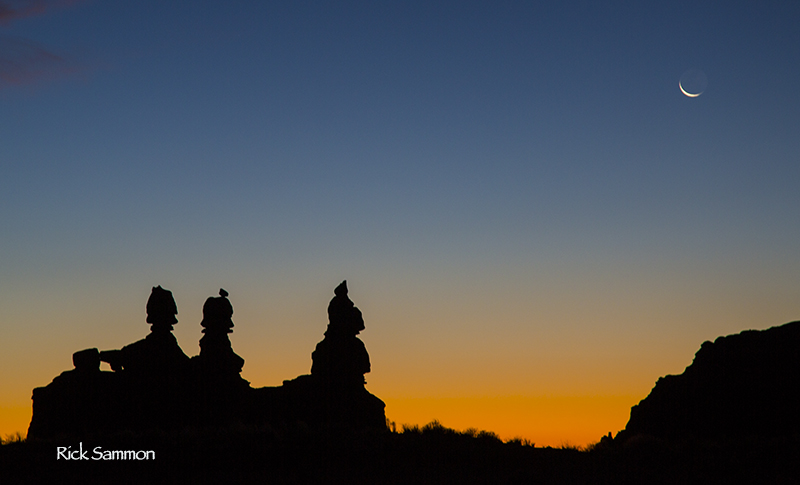
Don't let the shutdown of our National Parks shutdown your photo fun and creativity. Shoot in and around State Parks. That's what we did last week on my Southwest Photo Workshop Caravan. Some of my favorite images are in my new gallery - Southwest State Parks.

We shot in:
Dead Horse Point State Park
On the Colorado River near Arches
Goblin Valley State Park
Devil's Garden
Along the road between Bryce and Zion (Junkyard shots in Gallery)
Outside of Arches

Explore the light,
Rick

Speaking of web site galleries . . . they are super easy to create on a Squarespace site. Click the image below to get started.

Today's Guest Blogger: Rob Dweck

dweck001.jpg

Earlier this year I attended a talk by an award winning landscape photographer who is an authority on photography, printing, and color management. His presentation was filled with beautiful photographs and the knowledge that he shared was encyclopedic. At one point he said, and I’m paraphrasing here, that the technology in the cameras and software we use today is so advanced, that it can portray what we see exactly how it appears, and it should only be used for that purpose. I strongly disagree with the second part of the last sentence.

As he ranted against the photographers who take artistic liberties with their RAW files, and commit what he saw as crimes against photography, I was profoundly discouraged to hear him tell a room full of photographers not to explore their every creative impulse.

dweck002.jpg

I bring this up for a couple of reasons: First, because I feel that photographers, and all artists, should be encouraged to broaden their skills and discover new ways of expressing themselves. Specializing in one style or technique is something that you may choose to do at a certain point, but exploring a variety of techniques and styles is helpful in the early stages of your development as an artist. Even after you’ve found your specific style, there is always more to learn by experimenting and playing with different techniques.

The second reason is because in my continuing journey as a photographer, I am less interested in presenting a scene as it appeared, and prefer creating my own interpretation. One of my favorite photographers, Joel Tjintjelaar, said it far better than I could: “The further the artist moves away from reality, the more unique the result is, the more it represents his personal vision and the closer we get to experience the essence of that artist."

dweck003.jpg

When I’m focused and have a clear vision of how I want to present my subject, I can show it in a way that is different from how it is usually seen. When I move away from reality and bring my vision to the image, viewers tend to stop, look a little longer and gaze a little deeper. If I can’t show something entirely new, I’ll attempt to show the familiar in a new way. I don’t always succeed, but when I do, it more than makes up for the times when I am not successful.

“There is no such thing as taking too much time, because your soul is in that picture.”
-Ruth Bernhard

I first heard this from the amazing Parish Kohanim, and it stuck with me. It serves as a reminder to keep working at an image until everything is exactly how I want it. That often means going back and re-shooting under better light or at a different time of day or year – whatever it takes to make sure the final print comes out exactly how I envision it.

dweck004.jpg

Reality has been altered to some degree in each of the photographs in this post. In most cases it’s a combination of camera settings and post-processing. In each case, I had a clear vision of the final print, so it was just a matter of using the right tools to bring that vision to life. I’m not trying to make it sound easy, because it wasn’t. These images are the result of many hours of work and lots of trial and error.

dweck005 copy.jpg

The truth is, failure is not an option, it’s a given. Not every click of the shutter is going to yield a masterpiece. For every great shot you get, you’ll throw away a hundred, maybe two or three hundred. But when you get that one keeper, it’s all worth it. The technology we have available to us can be used not only to recreate what we see, but to create almost anything we imagine. Take those pixels, shape and polish them until a part of you is in there. You’ll know when that happens, and so will everyone who sees it.

For more of my work, please visit my web site

Onward and Upward

rick sammon copy 2.jpg

My Southwest Photo Caravan Workshop is over. We all made great pictures and had a ton of fun, even though the National Parks were closed. 

I hope you can join a workshop someday. I'm here to help.  

All my workshops are listed on my 2014 Workshop page

As my dad used to say, "Onward and upward." 

Explore the light, 
Rick

All This Week: Arches, Bryce and Zion Images

rick sammon copy 2.jpg
My Southwest Photo Caravan Digital Photography Workshop is well underway. Even though all the National Parks are closed, we are still making great images, making new friends and having wonderful experiences.

Above: On the way to Goblin Valley State Park. Below, Arches National Park before it closed.

rick sammon milky way copy.jpg

For more images, see my Google+ page.

All my workshops are listed on my 2014 Workshops page.

Explore the light,
Rick

P.S. Below: I'm getting ready to shoot before the workshop started :-) 

photo.JPG